
Metal to Workload. One Platform.
Cruz Compute Controller, C3, manages the complete infrastructure lifecycle, from bare metal rack discovery to running AI workloads, across every GPU vendor and every scheduler, from a unified agentic control plane.
Metal-to-Workload Pipeline
STAGE 1
Discover
Redfish / BMC auto-discovery of GPU racks and servers
STAGE 2
Cluster
Form bare metal or Kubernetes clusters from discovered nodes
STAGE 3
Platform
Compose scalable units with networking, storage & GPU topology
STAGE 4
Schedule
Multi-scheduler orchestration — SLURM, Run:ai, KAI unified
STAGE 5
Workload
Submit training jobs, inference endpoints, MIG-partitioned workloads
STAGE 6
Observe
GPU telemetry, FinOps metering, tenant cost allocation
Two Modules. One Platform.
Infrastructure Meets AI Operations
C3 is architecturally split into two complementary product modules that cover the full metal-to-workload setup, rack lifecycle, and AI ML operations.
Open Rack Controller
Rack-scale infrastructure management. Discover hardware, form clusters, provision platforms, from a single rack BMC to a fleet of GPU servers.
- Bare metal discovery via Redfish, iDRAC, and BMC protocols
- Rack management with full power, thermal, and topology visibility
- Kubernetes cluster lifecycle: create, discover, health-check
- CNI detection, driver registry, and network validation
- Composable platform provisioning across scalable units
-
GPU driver registry and automated installation
AI Cluster Orchestrator
GPU-aware workload orchestration. Allocate GPUs, manage schedulers, run training jobs, and meter consumption, across every vendor.
- Multi-scheduler orchestration: SLURM, Run:ai, and KAI from one API
- GPU allocation with full-device and MIG slice granularity
- NVLink topology-aware scheduling
- Real-time GPU telemetry: utilization, temperature, power, throttling
- Multi-tenant GPU quotas with N:N scheduler-tenant mapping
- FinOps cost metering per tenant, per workload, per GPU-hour
- Inference endpoint management: vLLM, Triton, KServe
From Rack-Scale to Fleet-Scale
C3 manages GPU infrastructure in two complementary modes for maximum flexibility and density.
Risk Management
Scalable Units
A single rack BMC is the entry point. All GPUs are interconnected within the rack via NVLink Switch Trays.
Ideal for maximum-density AI training with tightly coupled GPU interconnects.
Compose clusters from distributed GPU servers. Multiple discrete GPU servers are networked together into composable platforms. Each server's BMC is discovered individually or through a K8s control plane. Inter-node fabric (InfiniBand, RoCEv2/Ethernet) is provisioned as part of the platform.
Built Different.
Purpose-built for the GPU datacenter era — a ground-up platform for multi-vendor, multi-scheduler GPU infrastructure.
Multi-Vendor GPU
Manage NVIDIA, AMD, and Intel accelerators from the same control plane. Your GPU vendor wins on silicon merit, not management lock-in.
Multi-Scheduler
SLURM, Run:ai, and KAI orchestrated through a unified abstraction layer. Mix schedulers across partitions within the same platform.
Topology Aware
NVLink fabric topology drives GPU-aware scheduling. Jobs land on physically optimal GPU groups, not random allocations.
MIG Slicing
Full MIG partition lifecycle — create, delete, query profiles. Run inference on GPU slices while training owns the rest.
FinOps Built-in
Per-tenant, per-workload, per-GPU-hour cost metering. Know exactly what each team consumes and allocate GPU spend with precision.
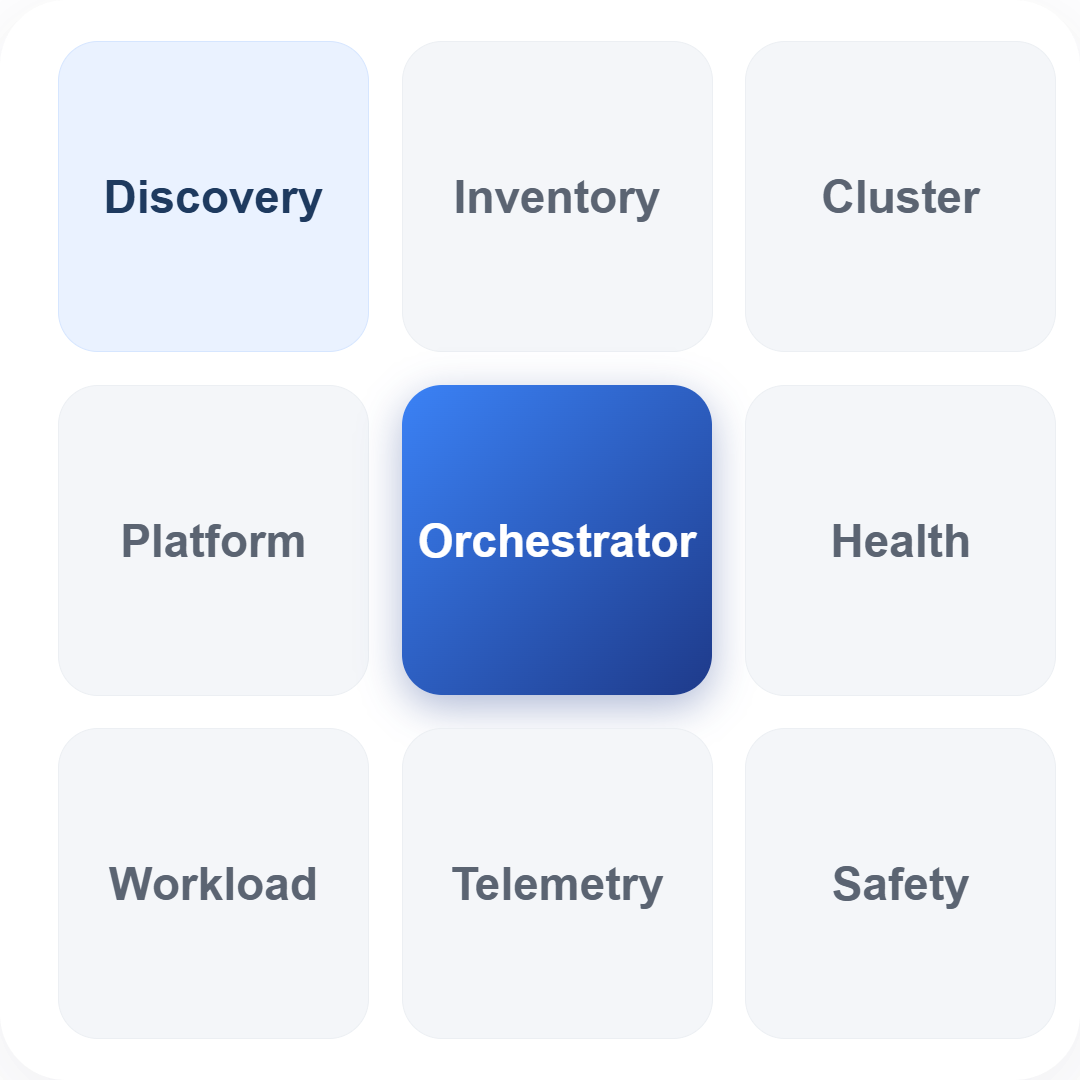
Leverage Cruz's Native Agentic AI with Cruz AI Vision
Nine autonomous agents manage every stage of the Metal-to-Workload pipeline. They discover racks, form clusters, provision platforms, allocate GPUs, and submit workloads, continuously and without scripts.
Humans don't push buttons. They supervise. Every critical decision surfaces for approval. Agents learn from supervisory feedback through adaptive memory, getting smarter with every deployment cycle.